Sukkur-Hyderabad Motorway (M-6) Update: Full Construction Set to Launch in November 2026
The long-awaited missing link in Pakistan’s national transport spine is finally transitioning from administrative delays to active ground construction. Federal Minister for Communications Abdul Aleem Khan confirmed that full physical work on the 306-kilometer Sukkur–Hyderabad Motorway (M-6) will formally commence in November 2026.
The M-6 section serves as the final, crucial segment of the Peshawar-to-Karachi Motorway (PKM) corridor. Once completed, it will connect the trade networks of northern and central Pakistan straight through to the major port cities of Hyderabad and Karachi.
We’ve heard start dates before. This one is different because the biggest obstacle is gone.
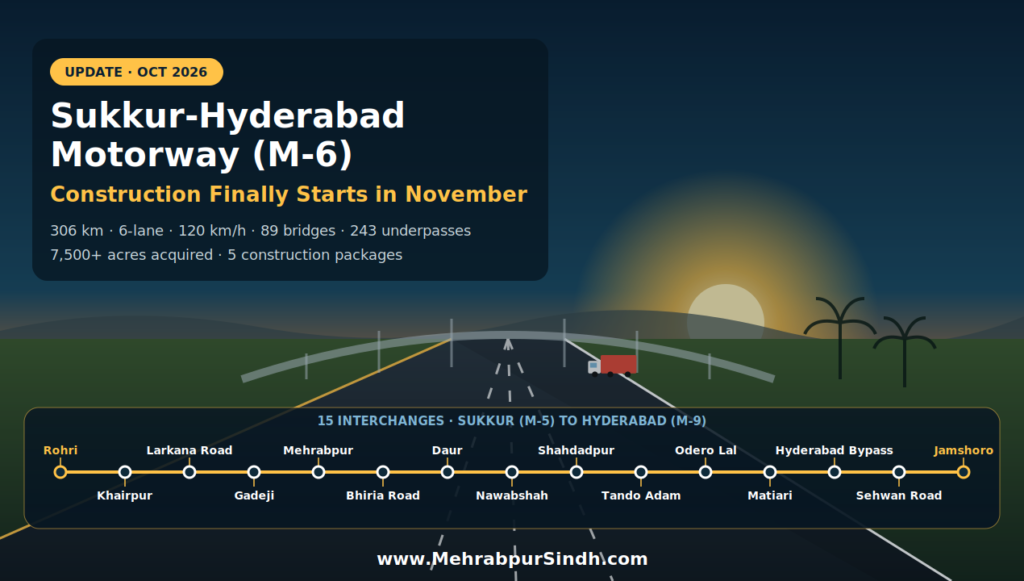
Sectional Analysis: How the Interchanges Create Regional Synergy
The 15 interchanges are structured to support distinct economic zones across the province of Sindh:
1. The Upper Sindh & M-5 Transition Zone (Exits 1–4)
The northernmost segment focuses on bridging the existing motorway network and serving heavy-industry districts.
- Rohri Sukkur (EXIT 1) serves as the critical terminal node, seamlessly merging traffic from the completed M-5 (Multan–Sukkur) Motorway into the M-6. This ensures the North-South corridor remains unbroken.
- Interchanges at Khairpur (EXIT 2) and Gadeji (EXIT 4) directly access the National Highway (N-5), providing essential entry points for the region’s dominant cotton ginning and date processing industries. Larkana Road (EXIT 3) crucially links the left-bank highway to the right-bank districts, utilizing existing Indus River bridges.
2. The Central Sindh Agricultural Spine (Exits 5–10)
This mid-section is the logistical lifeline for the fertile central plains.
- Mehrabpur (EXIT 5) emerges as a key economic catalyst. By connecting to Mehrabpur Road, this interchange opens a direct trade conduit for the busy grain markets, cotton warehouses, and agri-business centers of Mehrabpur town, bypassing congested local arterial roads.
- Nawabshah (EXIT 8), linked via Sakrand Road, is arguably the most complex node, serving the major provincial airport, multi-lateral universities, and considerable manufacturing/sugar refining industries of Shaheed Benazirabad.
- Nodes at Shahdadpur (EXIT 9) and Tando Adam (EXIT 10) provide the necessary gateway to the intense agricultural yields of Sanghar district, prioritizing the movement of cotton and sugarcane.
3. The Southern Sindh & M-9 Port Gateway (Exits 11–15)
The final segment integrates lower Sindh into the high-speed route and directs long-haul traffic toward the primary seaports.
- Odero Lal (EXIT 11) and Mitiari (EXIT 12) connect the cultural heartland and massive agricultural belts of Matiari (famed for bananas and sugarcane) to the main corridor.
- Hyderabad (EXIT 13) allows freight to entirely bypass the densely populated and often gridlocked inner-city streets of Hyderabad when traveling south.
- Sehwan Rd (EXIT 14) is unique in providing a necessary link to the Indus Highway (N-55) on the right bank of the river, connecting to key energy hubs and shrine cities.
- Jamshoro (EXIT 15) acts as the southern terminal, merging the M-6 directly into the operational M-9 Motorway (Hyderabad-Karachi), finalizing the 1,100km+ continuous motorway link to Karachi Port and Port Qasim.
1. Land Acquisition Cleared Across All Sections
A persistent hurdle for heavy infrastructure projects in Sindh has been land assembly. The Ministry of Communications verified that over 7,500 acres of land required along the alignment have now been fully acquired. Clearing this land title bottleneck allows heavy machinery and contractors to deploy without right-of-way disputes.
RADIO PAKISTAN
2. Segmented Execution for Rapid Delivery
To prevent delays across the 306 km expanse, the National Highway Authority (NHA) divided the M-6 project into five distinct construction packages.
- Parallel Workflows: By breaking the route into five sections, multiple contractors will work simultaneously rather than sequentially.
- Resource Management: Division allows local site logistics, material sourcing, and environmental clearances to move at a faster, localized pace.
3. High-Level Groundbreaking Scheduled
A formal inauguration ceremony is planned for late October or early November 2026 to mark the deployment of heavy equipment. Top political and state leadership—including President Asif Ali Zardari, Prime Minister Shehbaz Sharif, Sindh Chief Minister Syed Murad Ali Shah, and PPP Chairman Bilawal Bhutto Zardari—have been invited to initiate the project.
Technical Specifications & Infrastructure Scope
The M-6 is engineered to meet high-speed international transit standards. Designed to handle heavy freight trailers alongside passenger vehicles, its key engineering metrics include:
| Feature | Specification |
|---|---|
| Total Length | 306 kilometers (6-lane access-controlled) |
| Design Speed | 120 km/h |
| Bridges & Structures | 89 major bridges, 15 interchanges, and 243 underpasses |
| Project Model | Public-Private Partnership (PPP) / Build-Operate-Transfer (BOT) |
| Connecting Highways | Joins M-9 (Hyderabad-Karachi) to M-5 (Sukkur-Multan) |
Why the M-6 Motorway Matters for Trade & Travel
Closing the National Freight Loop
Currently, drivers transitioning from the seamless M-5 Motorway at Sukkur are forced onto the single-carriageway bottlenecks of National Highway N-5 to reach Hyderabad and Karachi. The current route suffers from severe traffic congestion, slow freight movement, and higher accident rates.
The M-6 bypasses urban choke points, cutting freight travel times between central Punjab/KPK and Karachi ports by several hours.
Regional Economic Impact Across Sindh
The motorway traverses key agricultural and trade districts, including Khairpur, Naushahro Feroze, Nawabshah (Shaheed Benazirabad), and Matiari. Direct interchange access will allow agricultural producers to ship perishable produce—such as dates, mangoes, and cotton—to seaport terminals and urban markets faster and with lower spoilage losses.
What to Expect Next
With land claims settled and project structuring complete, physical mobilization, equipment staging, and earthworks across the five designated packages will begin through November 2026. Travel advisories and local detour arrangements for intersecting regional roads will be issued by the NHA as structural work on interchanges begins.